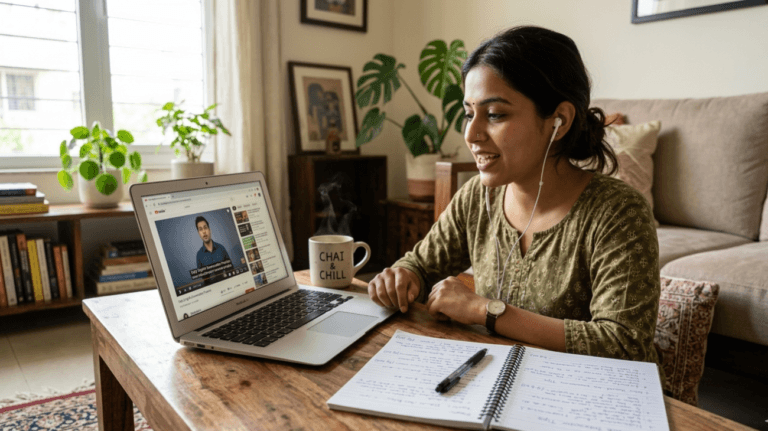

How to Use Telegram to Improve Your English Every Single Day

My phone is basically glued to my hand. I check it first thing in the morning, last thing at night, and probably fifty times in between without even thinking about it. For a long time, I spent all those hours scrolling, chatting, watching videos — and doing absolutely nothing useful for my English. I was constantly online and somehow never learning.
Then I started using Telegram differently. Not a new app, not a paid course. Just the same app I already had, used with actual intention. And it made a bigger difference than I expected.
Why Telegram Works for Daily English Practice
People usually think of Telegram as a messaging app and nothing else. That’s fair. But if you’re learning English, there’s a whole layer to this app that most learners scroll right past. Telegram has public channels, group conversations, voice messaging, and bots — all built in, all free, all available in almost every country in the world.
You don’t need to set up anything new. No extra account. No subscription to start. What you do need is a plan, because without one, you’ll join a few channels, lurk for a week, and quietly convince yourself that’s “studying.” It isn’t.
Building a Real Daily Habit Inside Telegram
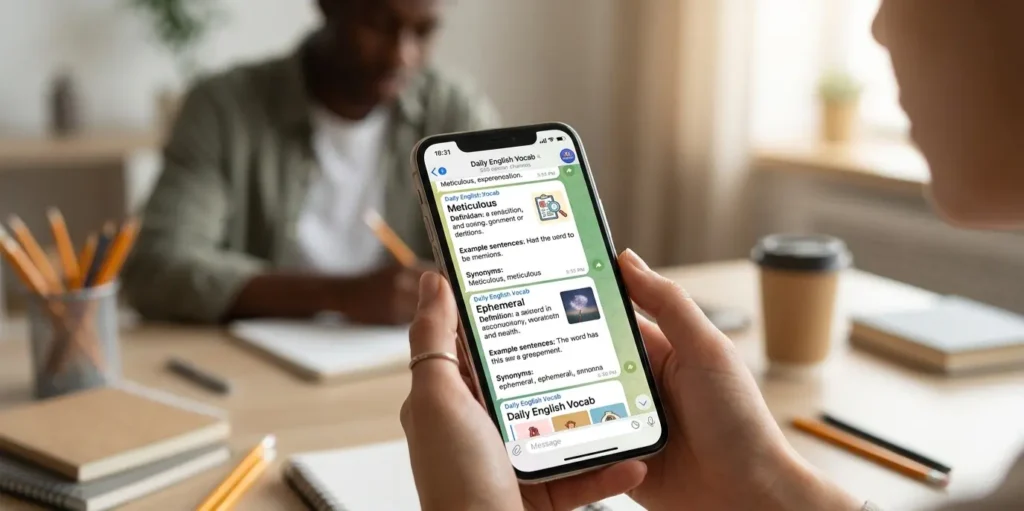
Here’s what actually worked for me. I joined three English channels. Just three — not twenty, not a whole folder of them. Three. One posted a new word every morning with a natural example sentence, not a dictionary definition. Another shared short voice clips of real people having casual conversations. The third was a group where members replied to each other in English about random topics — films, travel, food, whatever came up that day.
That third channel was terrifying at first. I remember typing a reply, deleting it, typing it again, reading it back three times, then finally sending something embarrassingly short. Two sentences, probably. But people responded. Normally. Kindly. And that tiny interaction did more for my confidence than any grammar exercise I’d done in months.
Start with channels that match something you genuinely care about, not just channels labelled “English learning.” If you follow fitness content, find an English-language fitness group. Into gaming? There are communities having full English conversations about it every day. When the topic matters to you, your brain holds onto the vocabulary because it has a real reason to.
relevant topic — “How to Practise English Speaking Alone at Home“
Using Voice Messages to Get Over the Speaking Fear
This is the part most learners completely avoid. Speaking. It’s the scariest part and, honestly, the most important. Roughly 70% of English learners say their biggest obstacle isn’t grammar at all — it’s the fear of opening their mouth and getting something wrong. I was exactly that person for a long time.
Telegram’s voice message feature quietly became one of my favourite tools for exactly this reason. I started sending short recordings to a study partner — sometimes just 20 or 30 seconds. A quick summary of something I’d read. A reply to a question they’d sent. Hearing yourself speak English out loud, even just to a recording, is one of the fastest ways to catch your own mistakes. Things you never notice when you’re thinking or typing suddenly become obvious the moment you hear your own voice.
I’ll be honest — listening back to those early messages was rough. My pronunciation wandered, my sentences tangled up halfway through, and I said “uh” so often it started to sound like punctuation. But I kept going. And a few months in, the difference was real and noticeable.
So, when was the last time you actually spoke English out loud today? Not just read it or listened to it — actually spoke? If the answer is “not yet,” a 30-second Telegram voice note is one of the lowest-pressure places to start.
What Most People Get Wrong About Language App Habits
Here’s an opinion that might push back a little on what you hear from most language coaches. The popular advice is that passive learning — reading posts, listening to audio, absorbing content — is basically useless without “active output.” I partly disagree with that.
Some of my best vocabulary came from Telegram channels I never once posted in. Reading how people actually phrase things in natural conversation, noticing idioms used in context, absorbing sentence structure through repetition — all of that built something real in my brain over time. It was slow. But slow isn’t the same as useless.
The real mistake isn’t passive learning — it’s treating it as the only thing you do. Mix it with writing and speaking and getting corrected, and all that passive input becomes something you can actually use. Telegram gives you both options at once. You can read and listen all morning, then jump into a group chat and practise actively in the afternoon. That’s a genuinely well-rounded learning environment, and it costs nothing.
Toby: The AI English Tutor Already Living on Telegram

Since we’re talking about Telegram bots — this is where I want to mention something that genuinely impressed me. There’s an AI English tutor called Toby that lives right inside Telegram at t.me/TalkToToby_bot. No new app, no separate account, just a bot you open and start practising with straight away.
What makes it feel different from a random chatbot is that it’s built specifically for English learners. Toby has over 100 real-life roleplay scenarios — job interviews, travel situations, ordering food, casual small talk — so the practice actually mirrors the conversations you’ll have in real life. It also does voice practice, which circles back to that speaking fear we talked about earlier, and it has IELTS prep if that’s your goal. There’s a free tier to try without committing, and a premium option for learners who want to go deeper. It doesn’t feel like a lesson. It feels like a conversation. Which, when you’re trying to build confidence in English, is exactly what you need.
Small Actions That Quietly Add Up
Here’s the daily routine I built, and it took me embarrassingly long to realise how simple it could be. Every morning, before I open any social media, I open Telegram. Five minutes. Read one English post. Reply to something. Sometimes send a voice message. That’s the whole thing.
Five minutes doesn’t sound like much. But five minutes every single day adds up to over 30 hours a year of intentional English practice. That’s a real course. Done for free, on an app you already have, before you’ve even had breakfast.
So here’s a question worth sitting with: what’s one small English action you could do on Telegram tomorrow morning, before you check anything else? Just one thing. Keep it small enough that you can’t talk yourself out of it.
You’re a Lot Closer Than You Think

Learning English doesn’t have to mean expensive courses, hour-long classes, or completely restructuring your day. Sometimes it just means using the app already on your phone — differently, and with purpose.
Telegram is free. It works almost everywhere. And when you use it with intention — good channels, genuine conversations, a practice partner like Toby — it stops being just a messaging app and starts being part of how you actually grow. The learners who reach fluency aren’t always the ones who studied the hardest — they’re the ones who showed up consistently, even when the sessions were short.
Your English is better than you think it is. And with one small action tomorrow morning, it’ll be a little better still. Start there.