
How to Build English Speaking Confidence When Naturally Shy

Quiet people don’t make bad English speakers. They actually make some of the best ones — once they get out of their own heads.
I know this because I was the kid in English class who knew every answer and raised zero hands. My grammar was solid. My vocabulary was decent. But the moment someone asked me to speak, my throat would tighten and whatever I wanted to say would just… evaporate. Sound familiar?
Here’s what took me years to figure out: shyness and speaking confidence aren’t opposites. You can be shy and still speak well. The two things aren’t fighting each other as much as we think. Building real speaking confidence in English has nothing to do with grammar — it’s the fear of being judged that holds you back.
Why Shy Learners Freeze Up (It’s Not What You Think)
Most advice tells you to “just practice more.” Speak to strangers. Join a class. Raise your hand. Great advice, terrible delivery. For shy people, that kind of pressure doesn’t motivate — it shuts us down even faster.
What’s actually happening when you freeze? Your brain is doing a threat calculation. It’s treating “saying something wrong in English” like a genuine social danger. And for shy learners, that system is a little more sensitive than average. That’s not a flaw. It’s just how you’re wired.
Roughly 40% of people around the world identify as shy, according to research from psychologist Philip Zimbardo. So if you feel alone in this, you really aren’t. The room is full of people quietly panicking alongside you.
The fix isn’t to stop caring what people think. That’s nearly impossible. The fix is to give yourself so many small, low-stakes speaking moments that your brain eventually stops treating English as a threat.
Start Smaller Than You Think Is Reasonable
Seriously. Embarrassingly small.
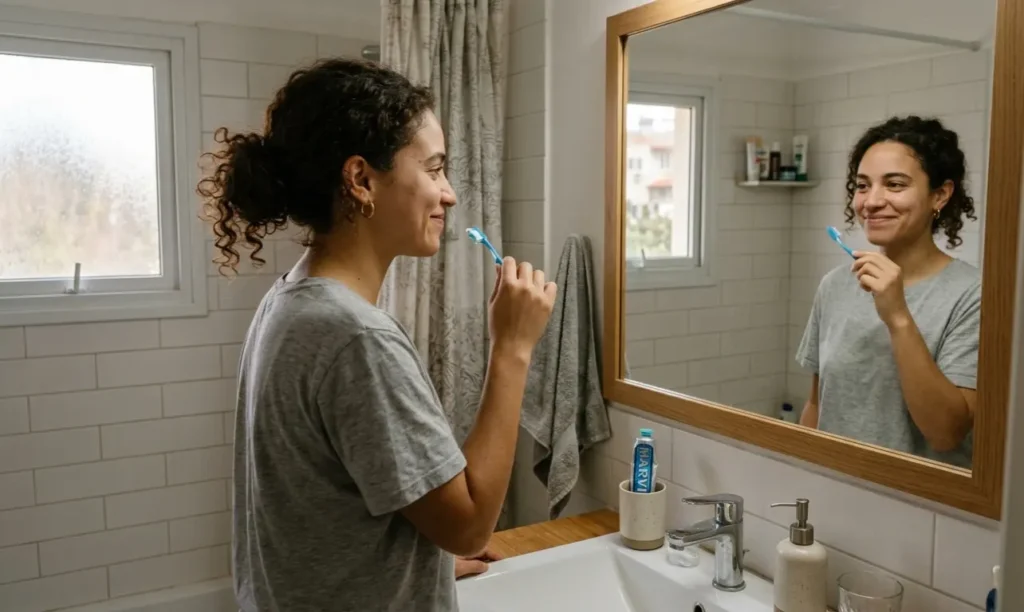
I once spent two full weeks doing nothing but talking to myself in the bathroom mirror in English. Five minutes every morning. I described what I was doing — “I’m brushing my teeth, the water is cold, I need coffee” — like I was narrating a very boring documentary. It felt ridiculous. But it worked.
No audience. No judgment. No one to disappoint. Just me and my reflection having a low-stakes conversation about toothpaste.
That’s what shy learners actually need first: a place to be bad at speaking with zero consequences. Once your mouth gets used to forming English sounds and your brain stops panicking, you can slowly add a real human to the equation.
The One Skill Shy People Actually Have (Use It)
Here’s my slightly controversial opinion: shy people have a huge hidden advantage, and almost nobody talks about it.
We listen. Really well.
Conventional wisdom says the way to improve at speaking is to speak more. And yes, that’s true eventually. But shy learners tend to absorb patterns, intonation, and natural phrasing from listening in a way that outgoing people sometimes skip. We’ve been watching conversations our whole lives. We’ve studied how people phrase things, how sentences flow, how native speakers pause and self-correct.
That listening habit, if you use it intentionally, becomes one of the fastest ways to sound more natural — even before you say a word. So before you beat yourself up for being quiet, recognize that your quiet has been teaching you things.
The key is turning that passive listening into active study. Watch English content — shows, interviews, podcasts — and try to repeat sentences out loud immediately after you hear them. Don’t translate. Just echo. Your brain already half-knows the pattern. You’re just waking it up.
Building Real Confidence: What Actually Moves the Needle
So what actually works for shy English learners? A few things, done consistently.
First: record yourself. I know. It’s painful. The first time I heard my recorded voice speaking English, I genuinely considered switching hobbies. But recording gives you real feedback. You’ll notice things you do well — and things that feel much worse in your head than they actually sound.
Second: pick one low-pressure real-world moment each day. Order your coffee in English. Reply to a comment online in English. Text a friend in English. Small, real interactions that don’t require performance. Just communication.
Third — and this is the one shy people resist most — let yourself be imperfect out loud. Not internally. Out loud. Say the wrong word. Laugh at yourself. Keep going. Confidence doesn’t come before the mistake. It comes after you survive one.
What Most People Get Wrong About Accents
Here’s where I’ll gently push back on something. A lot of advice tells shy learners to work hard on their accent to sound “more native.” And I get it — accent insecurity is real, especially when you’ve been mocked or misunderstood.
But chasing a native accent is often a trap. It sets an impossible, moving target. And it turns your focus away from the thing that actually matters: being understood. Clarity beats accent every time. I’ve met English speakers with heavy accents who communicate with total authority. And I’ve met people with technically perfect pronunciation who can’t hold a conversation because they’re too scared to start one.
Work on being clear. Work on being understood. Let the accent be yours.
A Tool That Helped Me Practice Without the Pressure
About a year into seriously working on my speaking, a friend pointed me toward Toby — an AI English tutor you can chat with on Telegram. What I liked was that it didn’t feel like a classroom.

You can do real voice practice, work through roleplay scenarios — there are over 100 of them — and even prep for IELTS if that’s your goal. For shy learners specifically, practicing with an AI first is genuinely useful. There’s no one to judge you. You can stumble over a sentence, start over, and try again. There’s a free tier if you want to test it out before committing: t.me/TalkToToby_bot. It’s not magic — you still have to do the work — but it’s a low-stakes place to build reps.
You Don’t Have to Stop Being Shy
Real talk: I’m still shy. I still feel a small jolt of nervousness before I speak English in a new group. I probably always will.
But here’s what changed — I stopped waiting to not feel nervous before I spoke. I started speaking while nervous. That gap, between feeling scared and speaking anyway, is where confidence actually lives. It’s not a feeling you get before you act. It’s a skill you build by acting anyway.

So — what’s the smallest speaking moment you could do today? Not tomorrow, not when your English is better. Today. Even if it’s just talking to your bathroom mirror about your morning. That counts. That’s how it starts.
Shy doesn’t mean silent forever. It just means you need a different on-ramp. And that’s completely okay.