
What Happens to English When You Practise With AI Every Day

Somewhere around week three, I stopped translating in my head.
I was washing dishes — not studying, not trying — and a thought came to me in English. Not my first language. English. Just casually, like it belonged there. I almost dropped the plate.
That’s when I knew something had actually changed.
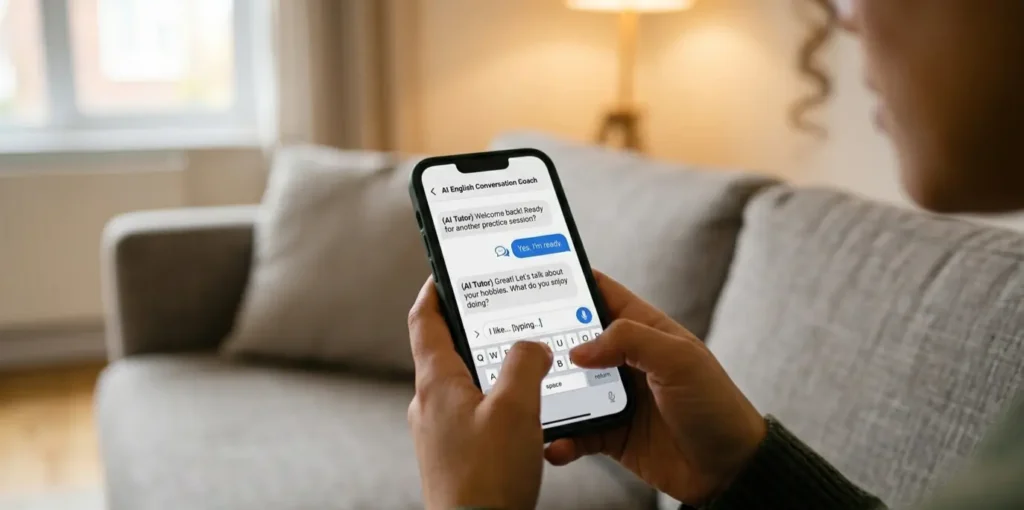
Daily AI English practice doesn’t feel dramatic. You open an app, you talk, you get feedback, you close it. Repeat. But underneath that routine, your brain is quietly rewiring. And I want to tell you honestly what that looks like — because it’s not what most people expect.
The Gap Between Knowing English and Using It
Here’s a question worth sitting with: how many grammar rules do you know that you’ve never actually used in a real conversation?
I knew what the present perfect tense was. I could explain it. I could pass a quiz on it. But the moment a native speaker said “Have you seen that show?” my brain just… stalled. I smiled and nodded. I had no idea what I’d just agreed to watch.
That gap — between knowing and doing — is where most English learners get stuck. And it’s not your fault. Traditional study builds knowledge. It doesn’t build reflexes.
Speaking fluently is a reflex, not a memory exercise. And reflexes only develop through repetition under low pressure. That’s exactly what daily AI practice provides.
What Actually Changes When You Practice Every Day
Let me be specific, because vague encouragement doesn’t help anyone.
The first thing that changes is your reaction time. In the beginning, someone asks you a question and there’s a 4-second delay while your brain searches for the right words. After a few weeks of daily practice, that gap starts shrinking. Not because you’ve memorized more words — but because your brain has practiced the act of responding faster.
The second shift is vocabulary. Not the formal kind you study from lists. The casual kind. Phrases like “that makes sense” or “I’m not sure, actually” or “can you say that again?” — the glue words that hold real conversations together. You start picking these up almost without noticing.
Roughly 70% of English conversation is made up of the same few hundred words and phrases used in flexible combinations. AI practice nails this, because it keeps pulling those patterns out of you through natural back-and-forth.
The third thing — and this one surprised me — is accent confidence. Not accent perfection. Confidence. You stop apologizing for how you sound because you’ve spent hours just talking, and the world didn’t end.
My Honest Opinion (Which Some People Disagree With)
Here’s where I’ll say something a little controversial: I don’t think accent reduction should be the goal.
Conventional advice pushes learners to “sound more native.” But I’ve met people with heavy accents who communicate brilliantly, and fluent-sounding speakers who can’t hold a real conversation. Accent isn’t the problem. Hesitation is. Fear is.
What daily practice actually fixes is the freeze. That moment where you know what you want to say but your mouth won’t cooperate. That’s what breaks down first — and that matters far more than how your vowels sound.
The Part AI Can’t Do For You
Okay, honesty time. I’m not going to pretend AI practice is a perfect solution, because it isn’t.
AI doesn’t get tired of you. It doesn’t judge you. It gives you a safe space to fail — and that’s genuinely valuable. But it also can’t replicate the unpredictability of human conversation. A real person might misunderstand you, change the subject suddenly, use slang you’ve never heard, or just talk too fast.
So the goal isn’t to replace human interaction. It’s to arrive at human interaction more prepared. Think of daily AI practice as the gym — and real conversations as the actual match.
Do you have even ten minutes a day you could use for this? That’s genuinely enough to start seeing a difference over a few weeks.

Finding the Right Place to Practice
I tried a few different tools before I found a rhythm that worked. A lot of apps felt like homework dressed up as something fun. They had progress bars and badges but not much actual conversation.
What I needed was something that felt like talking, not testing.
That’s why I’d recommend checking out Toby — it’s an AI English tutor that lives right in Telegram, so there’s no new app to download or interface to figure out. You just open a chat and start. It has voice practice, over 100 roleplay scenarios (job interviews, travel, small talk — real situations), and an IELTS prep path if that’s your goal. There’s a free tier, so you can try it without committing to anything. It’s not a magic fix, but it’s the closest thing I’ve found to a genuinely useful daily habit.
What to Expect After 30 Days
Thirty days sounds like a long time. It isn’t.
Somewhere around day ten, you’ll notice you’re less nervous before you start. Around day twenty, you’ll catch yourself using a phrase you learned without consciously trying to. By day thirty — if you’ve been consistent — you might have a small moment like mine. A thought that just arrives in English, without being summoned.
I can’t promise exactly when it happens. I’m not a linguist. (I once confidently told someone I was “very boring” when I meant “very bored” — so take my expertise with a grain of salt.) But I can tell you that the shift is real, and it’s worth the repetition.
Daily AI English practice works not because it’s smart technology, but because it gives you volume. Volume of speaking. Volume of feedback. Volume of low-stakes attempts until the language starts feeling like yours.

Your Daily Practice Starts Smaller Than You Think
You don’t need to overhaul your schedule. You don’t need to be brave, or fluent, or even confident. You just need to start one short conversation today — and then do it again tomorrow.
That’s how fluency actually builds. Not in big dramatic leaps, but in tiny daily acts of showing up. And if you keep showing up, the language starts meeting you halfway.
Give daily AI English practice a real try for thirty days. See what shifts. I think you’ll surprise yourself.
Related topics